

A-LAS / A-LAS-N

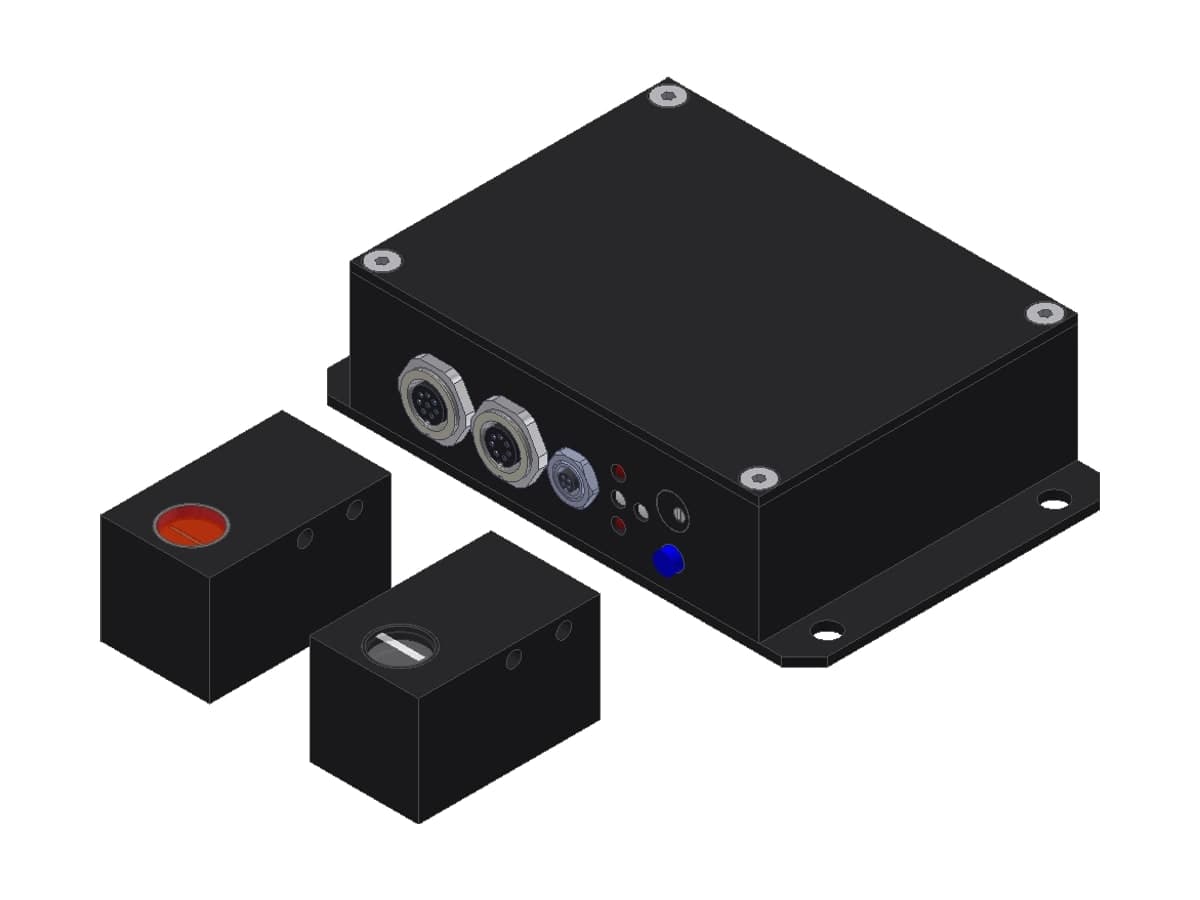
A-LAS analogue laser light barriers measure, position and detect objects from 0.01 mm with a parallel laser beam of homogeneous intensity.
A-LAS light barriers pass a parallel laser beam from aspheric glass optics through a precision aperture with a round or rectangular cross-section. This gives the beam a homogeneous light distribution and a sharp edge; the analogue output shows how much of the beam is covered. Depending on model and aperture, very fine objects such as threads are detected even at transmitter-receiver distances of up to 100 m.
The light barriers work with control units such as A-LAS-CON1 or SI-CON8; on the software-controlled units, threshold correction can be enabled. A-LAS-N types drive the laser in modulated (AC) mode to compensate for ambient light and are used with the single-channel SPECTRO-1-CONLAS or the two-channel SPECTRO-2-CONLAS evaluation units. FK-LAS-IR infrared laser barriers, for applications where visible laser light is unwanted, are part of the same group.
Key features
- Parallel laser beam; round or rectangular apertures for homogeneous light distribution and a sharp beam edge
- Light source: 670 nm solid-state laser, laser class 1
- Analogue signal 0–10 V, 100 kHz bandwidth (−3 dB)
- Reproducibility on fork types about 1 % of aperture size, 0.1 % with threshold correction
- A-LAS-N: ambient-light compensation by modulated laser; CONLAS units provide 2 digital outputs, 2 digital inputs, 0–10 V or 4–20 mA analogue output
- Fork or separate transmitter/receiver designs; nickel-plated brass or blue anodised aluminium housing, IP67 or IP54
Applications
Technical details
- Laser wavelength / class
- 670 nm / 1
- Minimum object size
- 10 µm
- Transmitter–receiver distance
- ≤ 100 m
- Analogue output
- 0–10 V
- Analogue bandwidth
- 100 kHz (−3 dB)
- Operating temperature
- 0 … +50 °C
Product information is compiled from the manufacturers' published documents and is for guidance only. Contact us for model selection, current specifications and pricing.
Other series in this group

L-LAS-LT
L-LAS-LT laser triangulation sensors measure the distance and thickness of objects without contact; short-range types resolve typically 1 µm.
L-LAS-TB / L-LAS-RL / L-LAS-CAM
L-LAS line sensors evaluate transmitted or reflected light on a line detector to measure the edge, position and width of objects precisely.
Let us assess your application together
We test your sample in our laboratory and report on resolution, optics and lighting selection.