

D-LAS / F-LAS / M-LAS

D-LAS, F-LAS and M-LAS laser light barriers detect very small objects with a parallel laser beam and are used for counting, triggering and positioning.
D-LAS digital laser light barriers work with visible parallel laser light and round or rectangular apertures, detecting very small objects even at long transmitter-receiver distances. On types with threshold correction the switching threshold is continuously adjusted to the maximum value at the receiver, so dirt does not shift the switching point. Pulsed-light (AC) types are unaffected by ambient sources such as fluorescent lamps; constant-light (DC) types suit fast processes.
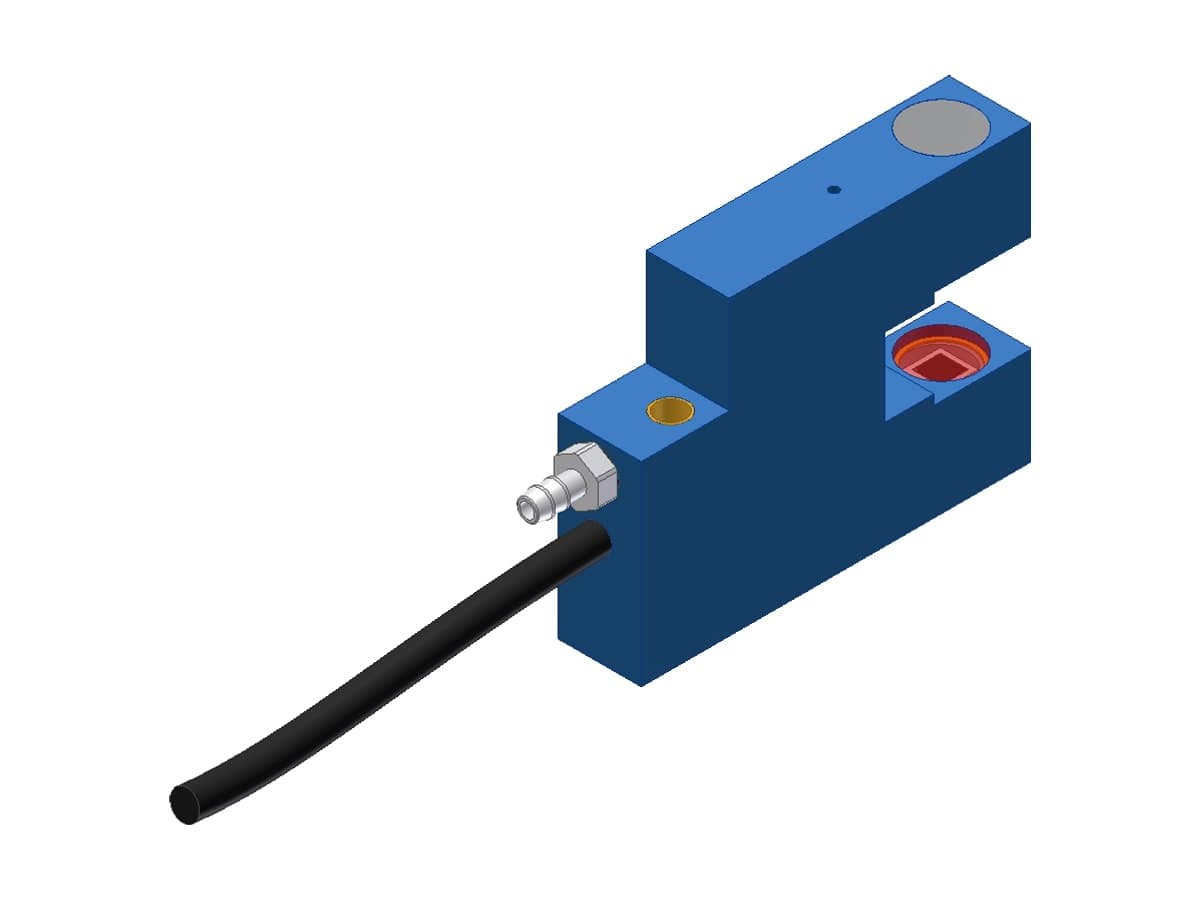
In F-LAS fork barriers the analogue signal falls in proportion to how much of the beam is covered; on DC-HS types the switching frequency reaches typically 200 kHz. M-LAS miniature barriers, with very small housings, are intended for detection and positioning in tight spaces where a small light spot is needed. With their sturdy metal housings, D-LAS barriers are designed for demanding applications in machine building.
Key features
- Light source: 670 nm solid-state laser, laser class 1 (D-LAS, F-LAS)
- Homogeneous beam through round or rectangular apertures; dirt compensation on types with threshold correction
- D-LAS1 and D-LAS2 provide an analogue monitor output in addition to the switching signal
- F-LAS: fork widths from 10 mm to 200 mm; switching frequency typically 25 kHz (DC) and 200 kHz (DC-HS)
- M-LAS: front ends measuring 30 × 11 × 7 mm, M-CON control units
- M8 or M12 connector depending on type; IP67 on most D-LAS and F-LAS types
Applications
Technical details
- Laser wavelength / class
- 670 nm / 1
- Switching frequency (F-LAS-DC-HS)
- 200 kHz
- Ambient light
- ≤ 5000 lx
- Supply voltage
- +24 VDC ±10 %
- Operating temperature (D-LAS, F-LAS)
- −20 … +50 °C
Product information is compiled from the manufacturers' published documents and is for guidance only. Contact us for model selection, current specifications and pricing.
Other series in this group

Let us assess your application together
We test your sample in our laboratory and report on resolution, optics and lighting selection.