
Removing stones and clods from the potato stream
Potatoes pass in a single layer on a wide belt under a short-wave infrared (SWIR) camera. Stones and clods that look like potatoes in visible light are told apart by their infrared response; their position is tracked with the belt encoder and the flap of that lane opens at the end of the belt.
The lane and the encoder position of the foreign object are sent to the PLC, which opens the flap at that point so the stone drops into the bin below. The removed count and the material map are shown on the operator display.
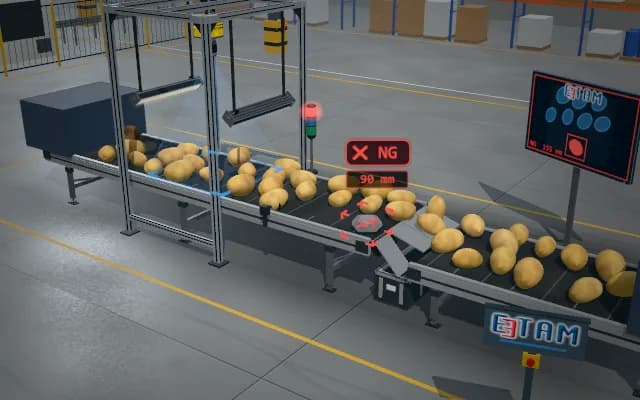
- 01 Stream
- 02 Acquire
- 03 Classify
- 04 Track
- 05 Reject
Potatoes travel on the belt in a single layer.
- Foreign objects removed
- —
- Distance to flap
- —
Scenes are illustrative simulations; they are not customer references or performance guarantees.
Need
A soil-covered potato and a stone or clod have the same colour and size in visible light, and shape is not a reliable cue either. Product lies randomly on the belt, with foreign material arriving between the potatoes and touching them.
Solution approach
A potato is mostly water and absorbs short-wave infrared light strongly, whereas stone and dry soil reflect it. In the infrared image taken under broadband light every region is assigned to a material class from this response. The position of the foreign object on the belt is carried to the belt end with encoder pulses, so the flap of the right lane opens at the right moment.
Process steps
- 01
Stream
Potatoes travel on the belt in a single layer.
- 02
Acquire
The camera takes the infrared image under broadband light.
- 03
Classify
Each region is classified as potato or foreign material from its infrared response.
- 04
Track
The position of the foreign object is tracked to the belt end with the encoder.
- 05
Reject
The flap of that lane opens and the foreign object drops into the bin below.
Related applications


Let us assess your application together
We test your sample in our laboratory and report on resolution, optics and lighting selection.