
Tear and edge-drift monitoring of conveyor belts
The empty return run is scanned from below by a line camera; oblique lighting reveals tears and edge breaks. An additional 3D profile measures belt-edge drift from a reference; non-conformity is sent to line control as a maintenance record and stop request.
Tear position and edge deviation are written to the maintenance record and marked on the operator display. A maintenance warning or stop request is sent to line control.

- 01 Infeed
- 02 Acquire
- 03 Analyse
- 04 Decide
The empty return run passes in front of the camera.
- Tear length
- —
- Edge deviation
- —
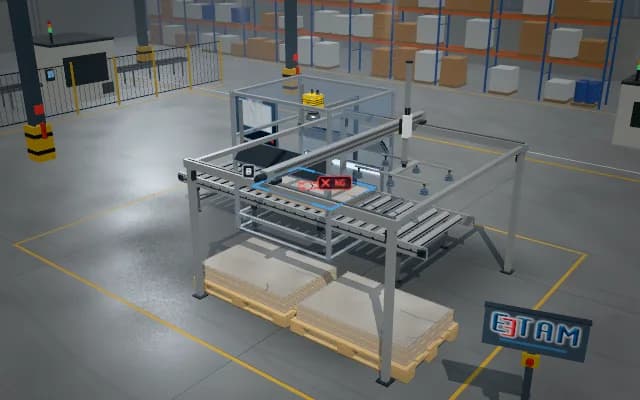
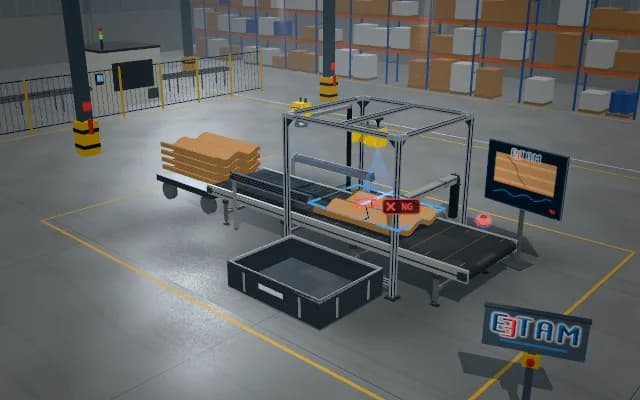
Scenes are illustrative simulations; they are not customer references or performance guarantees.
Need
The return belt vibrates and sags; dust streaks may resemble tears. Lateral belt drift can be confused with edge breakage, so edge position is tracked separately.
Solution approach
A lower line camera scans the return surface under oblique light; a light reference behind it separates openings from dust streaks. Longitudinal openings and edge discontinuities are segmented in the image assembled from belt travel. An additional 3D profile measures the edge against a mechanical reference to distinguish drift from tearing.
Process steps
- 01
Infeed
The empty return run passes in front of the camera.
- 02
Acquire
A lower line image and an edge profile are acquired.
- 03
Analyse
The longitudinal opening is segmented; offset from the edge reference is measured.
- 04
Decide
Non-conformity produces a maintenance record and a stop request.
Related applications


Let us assess your application together
We test your sample in our laboratory and report on resolution, optics and lighting selection.