
Marking and labelling systems
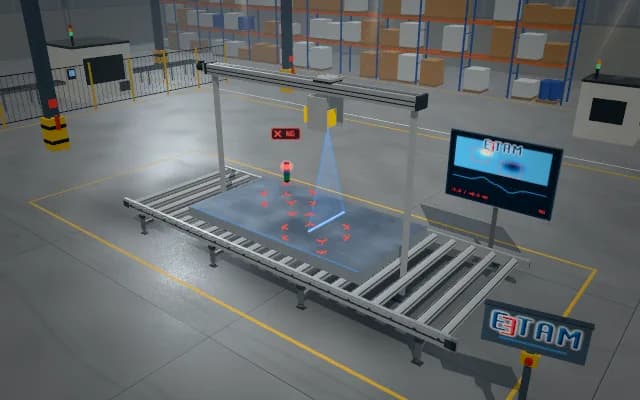
As the steel product moves down the line its identity code and text are laser-marked on the surface. At the next step a reader decodes the mark and measures its contrast and print quality. A plate that cannot be read is taken back and re-marked at a new position.
Code, contrast and grade appear on the display and HUD; an NG plate returns for re-marking, and the subsequent OK read determines that the plate may continue.

- 01 Marking
- 02 Transfer
- 03 Reading
- 04 Verify
- 05 Rework
The laser head marks the code and text on the plate surface.
- Decoded code
- —
- Contrast
- —
- Quality grade
- —
Scenes are illustrative simulations; they are not customer references or performance guarantees.
Need
Scale and reflective steel can reduce laser-mark contrast; missing code modules impair decoding. Rework needs verification of a new marking area rather than repeating the failed mark in place.
Solution approach
The indexing line stops the plate first at the laser head and then at an oblique reader; a photo-sensor indicates the reading position. The code region is isolated and decoding and contrast are evaluated. An NG plate reverses, receives a mark in a second area and is read again to verify OK.
Process steps
- 01
Marking
The laser head marks the code and text on the plate surface.
- 02
Transfer
The line indexes one step; the marked plate stops under the reader.
- 03
Reading
The reader decodes the mark; contrast and print quality are measured.
- 04
Verify
The decoded data is compared with the production record, the grade with the threshold.
- 05
Rework
The line reverses and the plate is re-marked at a new position on the surface.
Related applications




Let us assess your application together
We test your sample in our laboratory and report on resolution, optics and lighting selection.