
Damage detection in borescope images
A flexible borescope is lowered through an access port into an engine on its maintenance stand; each blade is imaged as the blade row is indexed. A deep-learning model segments an edge notch in the image; the finding is stored with the blade number and the review decision is left to the operator.
The damage mask and the selected borescope frame are stored with the blade number; the operator confirms the finding on the display and directs the maintenance review.
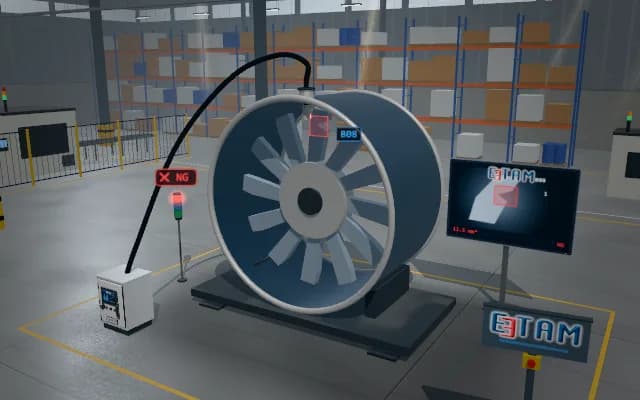
- 01 Probe
- 02 Blade
- 03 Acquire
- 04 Segment
- 05 Report
The flexible tip is lowered into the engine through the access port.
- Inspected blade number
- —
- Marked findings
- —
- Mask area
- —
Scenes are illustrative simulations; they are not customer references or performance guarantees.
Need
View angle, glare and probe motion keep changing in the narrow engine space. Seeing the same blade in several frames can link a finding to the wrong blade number.
Solution approach
The side-viewing tip of the probe lowered through the access port lights the blade surface; the row advances one blade per step and the blades are counted. A deep-learning model segments notch, crack and coating-loss regions. The selected frame and mask are linked to the blade number for operator assessment.
Process steps
- 01
Probe
The flexible tip is lowered into the engine through the access port.
- 02
Blade
The blade row turns one step to present the next blade.
- 03
Acquire
A borescope frame is captured under the tip light.
- 04
Segment
The model marks the damage region with a mask.
- 05
Report
The finding is presented to the operator with the blade number.
Related applications




Let us assess your application together
We test your sample in our laboratory and report on resolution, optics and lighting selection.