
Delamination detection in composite panels by active thermography
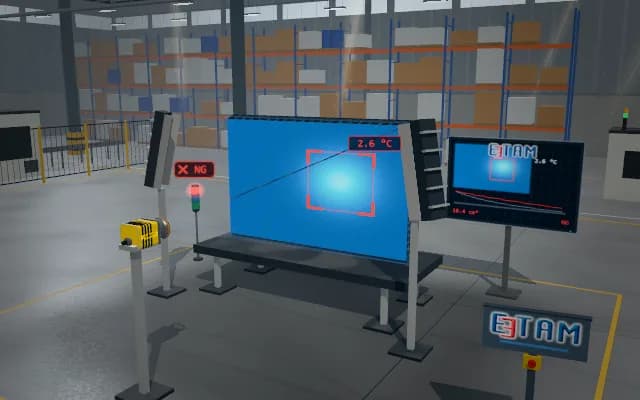
A short heat excitation is applied to the front of a composite panel in its fixture. A thermal camera records the cooling sequence; a response region departing from the reference is marked in panel coordinates and passed to NDT review.
Thermal-response difference, anomaly area and panel coordinates are added to the inspection record; the NG region is assigned to NDT assessment on the operator display.
- 01 Fixture
- 02 Excite
- 03 Cooling
- 04 Response
- 05 Review
The panel is seated on its reference points.
- Response temperature difference
- —
- Anomaly area
- —
- Time after excitation
- —
Scenes are illustrative simulations; they are not customer references or performance guarantees.
Need
Ply separation may leave no visible trace on the surface. Emissivity differences and uneven heat excitation can create temperature patterns that resemble an internal void.
Solution approach
Two flash sources heat the panel face with a short pulse; a thermal camera on the same side collects the cooling frames. Heat cannot diffuse into the depth above a ply separation, so that region cools more slowly than its surroundings. Local cooling curves are compared with the sound surroundings; the slower-cooling area is mapped to panel coordinates and marked for review.
Process steps
- 01
Fixture
The panel is seated on its reference points.
- 02
Excite
The flashes apply a short heat pulse to the front face.
- 03
Cooling
The thermal camera accumulates the cooling sequence.
- 04
Response
Local cooling curves are compared.
- 05
Review
The abnormal response region enters the NDT record.
Related applications




Let us assess your application together
We test your sample in our laboratory and report on resolution, optics and lighting selection.