
Quality grading and verification of direct-part-marked 2D codes
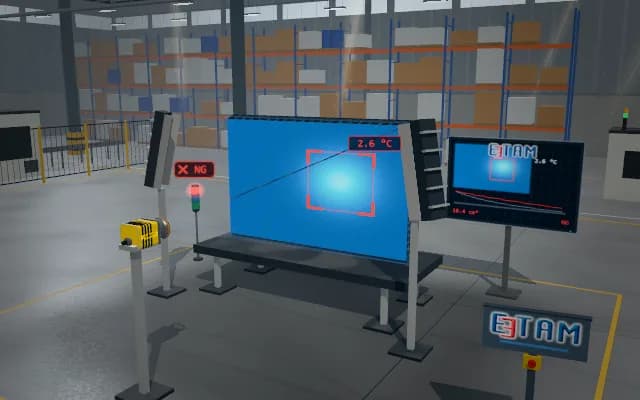
A metal part leaving marking stops in the verification fixture. A fixed verifier evaluates the code and its quality criteria under a defined lighting geometry; a low grade is linked to a remarking decision.
Code content and grading criteria are linked to the MES record; a remarking request for a low-grade mark is shown on the operator display.

- 01 Fixture
- 02 Illuminate
- 03 Decode
- 04 Grade
- 05 Report
The marked part enters the verification nest.
- Illustrative quality grade
- —
- Module contrast
- —
- Decode (1 = success)
- —
Scenes are illustrative simulations; they are not customer references or performance guarantees.
Need
Code and substrate can show similar brightness on metal. Dot shape, missing modules and directional reflections affect readability; decoding alone does not establish the quality grade.
Solution approach
The fixture fixes the part position and the verifier images the code under a defined lighting geometry. Module contrast, pattern integrity and decoding are evaluated together. Content is compared with the expected record; the grade and its criteria are reported.
Process steps
- 01
Fixture
The marked part enters the verification nest.
- 02
Illuminate
The defined lighting geometry illuminates the code surface.
- 03
Decode
Code modules and content are extracted.
- 04
Grade
Contrast and pattern criteria are evaluated.
- 05
Report
A low grade produces a remarking request.
Related applications




Let us assess your application together
We test your sample in our laboratory and report on resolution, optics and lighting selection.