
Textile recycling sorting system
Textile pieces on a fast belt are imaged by colour and near-infrared line-scan cameras, and an AI model assigns each piece to a fibre class. At the end of the belt, air jets direct the pieces into separate bins by class.
Class and belt position of every piece are sent to the jet control; the jet for its class fires, and a blended or unidentified piece drops into the residue bin. Class counts are followed on the operator display.
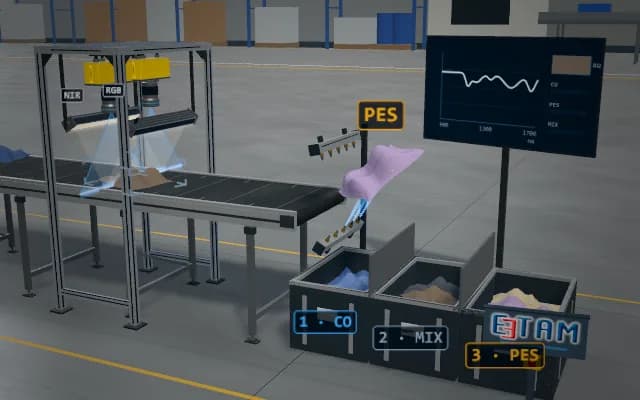
- 01 Infeed
- 02 Scan
- 03 Classify
- 04 Eject
Textile pieces arrive spread in a single layer on a fast belt.
- Fibre class
- —
- Piece area
- —
- Target bin
- —
Scenes are illustrative simulations; they are not customer references or performance guarantees.
Need
The pieces are irregular, creased and mixed in colour; cotton and polyester of the same colour cannot be told apart in visible light. On a fast belt the decision for each piece must be made before it reaches the end.
Solution approach
At the sensor line a colour and a near-infrared line-scan camera image the same cross-section; fibre type is read from the absorption bands of the NIR signature and colour from the visible channel. An AI model evaluates the two signatures together and assigns the piece to a fibre class; at the end of the belt the air jet matching the class directs the piece into its bin.
Process steps
- 01
Infeed
Textile pieces arrive spread in a single layer on a fast belt.
- 02
Scan
The colour and near-infrared cameras capture the signature of each piece at the same cross-section.
- 03
Classify
The AI model assigns the piece to a fibre class: CO, PES or blended.
- 04
Eject
At the end of the belt, air jets direct the piece into the bin of its class.
Related applications





Let us assess your application together
We test your sample in our laboratory and report on resolution, optics and lighting selection.