
In-line fabric defect analysis during production
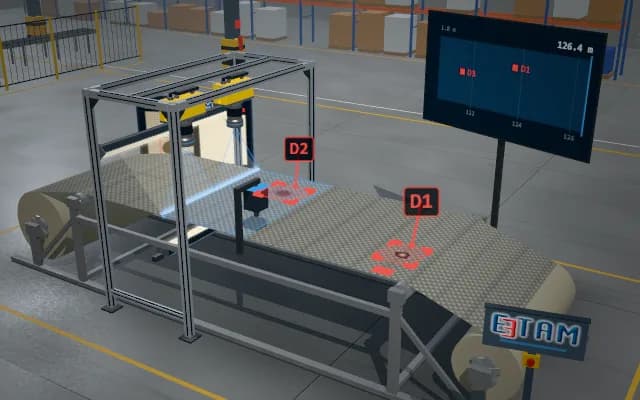
The fabric runs under a line-scan camera bar at production speed. Defects such as holes, stains and missing threads are found in the reflected and transmitted-light images, classified, marked at the fabric edge and entered in the roll map with their metre position.
Class, size and metre position of every defect are written to the roll map; the edge marker tags the defect line, and the map is passed to the cutting and grading system.
- 01 Scan
- 02 Detect
- 03 Classify
- 04 Log
The fabric runs under the camera bar; the reflected and transmitted-light images build up line by line.
- Position
- —
- Defect class
- —
- Size
- —
Scenes are illustrative simulations; they are not customer references or performance guarantees.
Need
While the fabric runs at production speed, a small hole or a missing thread disappears into the pattern of the weave; weave repeat, creases and edge wander produce false detections. The metre position of every defect on the roll must also be known.
Solution approach
Line-scan cameras covering the fabric width build the image line by line; a low-angle bar light from above brings out surface defects, while transmitted light from below reveals holes and thin weave. The weave repeat is modelled, a region deviating from it is found in both channels, classified by its shape and matched with the metre counter of the line encoder.
Process steps
- 01
Scan
The fabric runs under the camera bar; the reflected and transmitted-light images build up line by line.
- 02
Detect
A region that deviates from the weave is found and its size is measured.
- 03
Classify
The defect is classified by its shape and its appearance in the two channels as a hole, a stain or a missing thread.
- 04
Log
The defect is entered in the roll map and the edge marker tags its position.
Related applications





Let us assess your application together
We test your sample in our laboratory and report on resolution, optics and lighting selection.