
Finger interruption check on solar cell metallisation
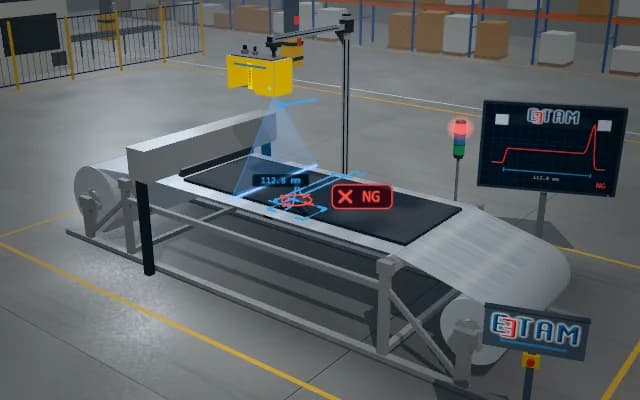
The printed cell stops below the camera on a vacuum carrier. Finger lines are followed under coaxial illumination; a cell with an interrupted or narrowed line is moved to the sorting tray.
Interruption location and line width are written to the cell record. A cell outside the recipe is moved to the sorting tray by the robot at the unload position; the inspection image is shown on the operator display.

- 01 Position
- 02 Illuminate
- 03 Acquire
- 04 Line analysis
- 05 Sort
The carrier stops the cell below the camera.
- Interruption length
- —
- Local line width
- —
Scenes are illustrative simulations; they are not customer references or performance guarantees.
Need
Thin conductive lines give angle-dependent, variable reflections on the shiny, textured cell surface. Print-edge roughness and angular offset of the cell on the carrier can hide a short interruption or a local narrowing.
Solution approach
A vacuum carrier holds the cell flat. Coaxial illumination sends light along the camera axis; in the perpendicular view the metal lines and the cell surface separate with stable contrast. In an image aligned to the cell edge each finger is followed along its length; gap length and local line width are compared with the recipe limits.
Process steps
- 01
Position
The carrier stops the cell below the camera.
- 02
Illuminate
Coaxial light illuminates the printed surface along the camera axis.
- 03
Acquire
A magnified image of the finger lines is captured.
- 04
Line analysis
Continuity and local width are measured along each finger.
- 05
Sort
The carrier moves to the unload position; a cell with interrupted print is moved to the sorting tray.
Related applications




Let us assess your application together
We test your sample in our laboratory and report on resolution, optics and lighting selection.