
Vial fill-level and foreign-particle inspection
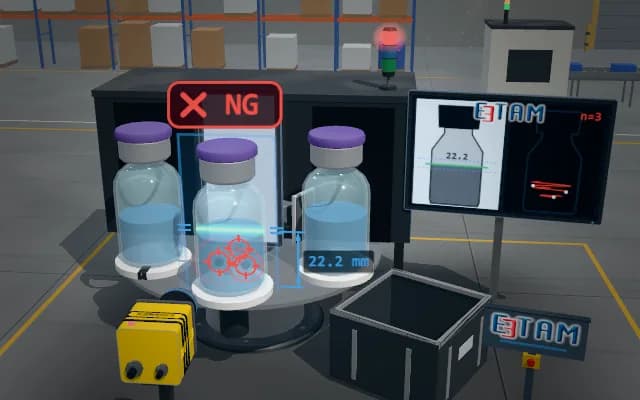
The vial stops in front of a backlight and its fill level is gauged in the silhouette image. It is then spun and stopped abruptly: particles that keep rotating with the liquid leave tracks in the difference of successive images, while static marks on the glass are ignored. A vial with under-fill or particles is rejected.
Level and particle count are logged per vial; a vial with under-fill or particles is pushed into the reject bin at the next station, and the operator display shows the silhouette and the motion tracks.
- 01 Index
- 02 Level
- 03 Spin-stop
- 04 Particles
- 05 Decide
The table indexes one station; the next vial stops in front of the backlight.
- Level
- —
- Particle count
- —
Scenes are illustrative simulations; they are not customer references or performance guarantees.
Need
A particle in the liquid is a tenth of a millimetre long and almost transparent; scratches, dust and print on the glass are far more visible in the same image. The liquid surface forms a meniscus, and foam or droplets shift the level edge.
Solution approach
The backlight turns the vial into a silhouette; the liquid–air boundary is found as a vertical edge and measured against the base reference. The vial is then spun fast and stopped abruptly: the glass stops, the liquid keeps rotating. Successive frames are subtracted; static marks on the glass cancel out, particles moving with the liquid remain as tracks and are counted.
Process steps
- 01
Index
The table indexes one station; the next vial stops in front of the backlight.
- 02
Level
The backlight strobes; the liquid surface is found as an edge in the silhouette and gauged.
- 03
Spin-stop
The vial is spun fast and stopped abruptly; the liquid keeps rotating.
- 04
Particles
Successive images are compared and moving specks are tracked.
- 05
Decide
Level tolerance and the number of moving particles are evaluated together.
Related applications


Let us assess your application together
We test your sample in our laboratory and report on resolution, optics and lighting selection.