
Damaged parcel and open-flap detection
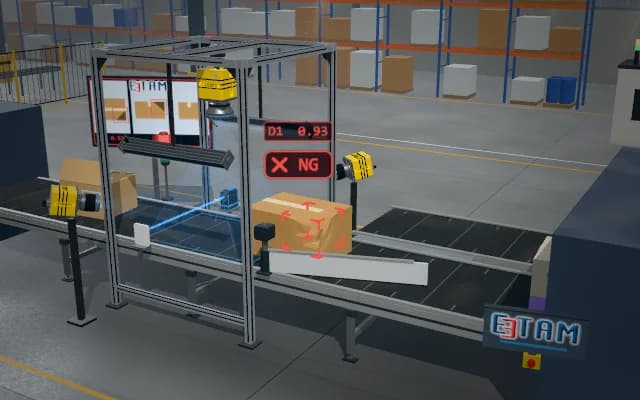
Every parcel entering the sortation line is imaged from above and from the sides as it passes through a camera tunnel. A deep-learning model separates dents, tears, wet stains and open flaps from the print and tape patterns of the parcel; a damaged parcel is routed to the manual inspection lane by a diverter flap.
The damage type, the face and the image are stored with the parcel identity and sent to the sorter controller. A damaged parcel is routed to the manual inspection lane by the diverter flap; a sound parcel continues in the flow.
- 01 Infeed
- 02 Acquire
- 03 Analyse
- 04 Decide
- 05 Divert
Parcels of different sizes approach the tunnel.
- Damage score
- —
- Damage area
- —
- Diverted
- —
Scenes are illustrative simulations; they are not customer references or performance guarantees.
Need
Every parcel differs in size, colour, print and tape; tape edges, labels and fold lines look like damage to rule-based analysis. Dents and wetness have low contrast, and it is not known in advance which face they will be on.
Solution approach
In the tunnel one top camera and two diagonal side cameras image five faces of the parcel; low-angle bar lights make dents and tears cast shadows. The deep-learning model is trained on images of sound and damaged parcels; it learns print, tape and labels as normal pattern and marks the damaged region with its type. The decision compares the area and score of the region with a threshold.
Process steps
- 01
Infeed
Parcels of different sizes approach the tunnel.
- 02
Acquire
The top and side cameras image five faces of the parcel.
- 03
Analyse
The model separates the damaged region from print and tape pattern.
- 04
Decide
The area and score of the region are compared with the threshold.
- 05
Divert
A damaged parcel is routed to the manual inspection lane by the flap.
Related applications




Let us assess your application together
We test your sample in our laboratory and report on resolution, optics and lighting selection.