
Missing-label and matrix residue check on label rolls
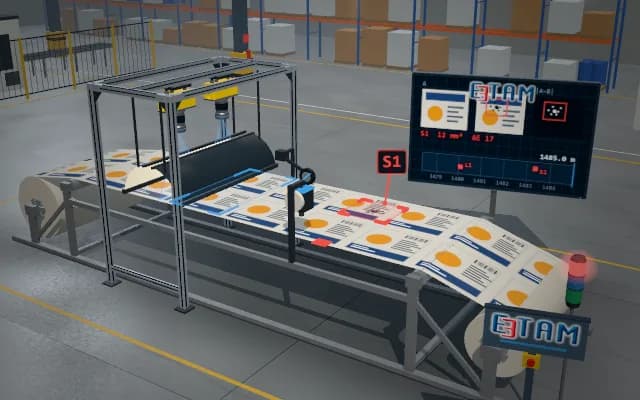
After die-cutting and matrix stripping the label web passes the inspection bridge of a slitter-rewinder. Light from below separates label from liner by the difference in thickness; when a missing label, unstripped matrix, off-register cut or splice is found, the machine stops and the faulty region is marked.
When a fault is found a stop signal goes to the rewinder control and the faulty region comes to rest on the repair table; the marker points out the region, and label count and fault position are written to the roll record.

- 01 Scan
- 02 Detect
- 03 Stop
- 04 Mark
The web passes the inspection bridge; the label array is imaged line by line against the backlight.
- Label count
- —
- Fault code
- —
- Position
- —
Scenes are illustrative simulations; they are not customer references or performance guarantees.
Need
A white label on a white liner is almost invisible in a top view; a missing label and an unprinted label look alike. Unstripped matrix is the same material as the label. Once wound, the faulty region stays inside the roll and causes a stop on the next line.
Solution approach
A backlight sits below the web: the liner transmits light while a region carrying a label appears darker; in this thickness image the line-scan camera separates the label array, the gaps and matrix residue. An area camera with a ring light from above checks the print position relative to the label edge. The encoder triggers the lines and counts the labels.
Process steps
- 01
Scan
The web passes the inspection bridge; the label array is imaged line by line against the backlight.
- 02
Detect
A missing cell or matrix residue is found in the array; the encoder position is recorded.
- 03
Stop
The machine slows down and the faulty region comes to rest on the repair table.
- 04
Mark
The marker points out the faulty region; after the repair the machine starts again.
Related applications





Let us assess your application together
We test your sample in our laboratory and report on resolution, optics and lighting selection.