
Finding the origin of a web break from recorded video
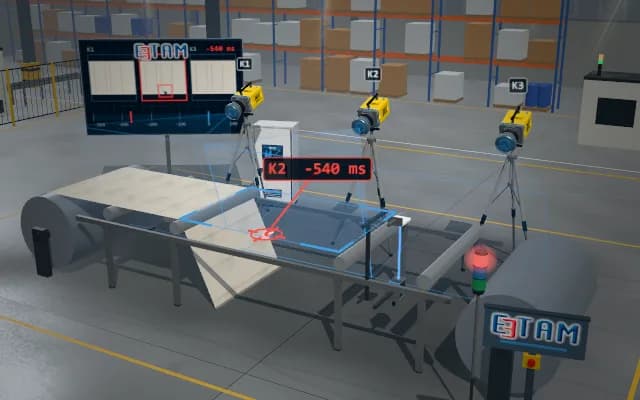
High-speed cameras facing the machine sections record continuously into a buffer. When the web breaks, the break detector freezes the buffer; the time-synchronised recording is played back and the first frame showing the tear is flagged for maintenance review with its camera and position.
The camera where the break started, the time relative to the trigger and the distance from the edge are written to the event record; the frame sequence is kept for maintenance review and attached to the downtime report.
- 01 Record
- 02 Trigger
- 03 Playback
- 04 Origin
The cameras record the running web continuously into the buffer.
- Camera
- —
- Time to trigger
- —
- Distance from edge
- —
Scenes are illustrative simulations; they are not customer references or performance guarantees.
Need
A break spreads across the whole web width in the blink of an eye; when the machine stops only the result is left. In which section the first tear started, at the edge or in the middle, and what happened just before cannot be seen with the naked eye.
Solution approach
A camera facing each machine section keeps the last seconds in a buffer that is overwritten continuously. The trigger from the break detector freezes all buffers with the same time stamp, so images from before and after the event are kept. The recordings are played back in sync; movement at the web edge and the opening tear are followed frame by frame to find the moment it first appears.
Process steps
- 01
Record
The cameras record the running web continuously into the buffer.
- 02
Trigger
The web breaks; the detector triggers and all buffers are frozen at the same instant.
- 03
Playback
The time-synchronised recording is followed backwards; the tear shrinks frame by frame.
- 04
Origin
The first frame showing the tear is flagged with its camera and position.
Related applications




Let us assess your application together
We test your sample in our laboratory and report on resolution, optics and lighting selection.