
Repeating equipment mark detection on tissue
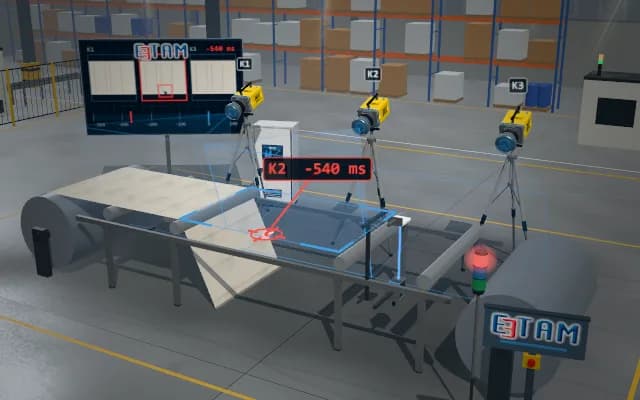
The tissue web passes under a fixed line-scan camera and low-angle light from two directions. The coordinate of every mark is recorded; marks recurring at equal spacing in the same cross-web position are matched with the circumference of a roll and a maintenance alarm names the source zone.
Repeat spacing and cross-web position are followed in the strip record on the operator display; the roll matching the spacing is reported to maintenance as the source zone by an alarm, and the record is added to the shift report.

- 01 Scan
- 02 Mark log
- 03 Repeat analysis
- 04 Source alarm
The web runs under the camera; as long as no mark is found the record is clean.
- Repeat count
- —
- Repeat spacing
- —
- Source zone
- —
Scenes are illustrative simulations; they are not customer references or performance guarantees.
Need
A small damage on a roll or felt leaves the same mark at every revolution. Seen one by one, each mark stays below the acceptance limit; on thin, embossed tissue it has low contrast, and searching for the source by hand along the line means a long stop.
Solution approach
Low-angle bar lights from two directions bring out dents and pressure marks by their shadow; the line-scan camera scans the web on encoder triggering. Machine-direction and cross-web coordinates of the marks are stored. The distance between marks that stay in the same lane is computed; if the spacing recurs, it is compared with the circumferences of the rolls on the line.
Process steps
- 01
Scan
The web runs under the camera; as long as no mark is found the record is clean.
- 02
Mark log
The first mark is found; its machine-direction and cross-web coordinates are stored.
- 03
Repeat analysis
The spacing between marks in the same cross-web position is measured and compared with the previous one.
- 04
Source alarm
The spacing matches the circumference of a roll; the source zone is reported to maintenance.
Related applications




Let us assess your application together
We test your sample in our laboratory and report on resolution, optics and lighting selection.