
Inline colour deviation measurement in printing
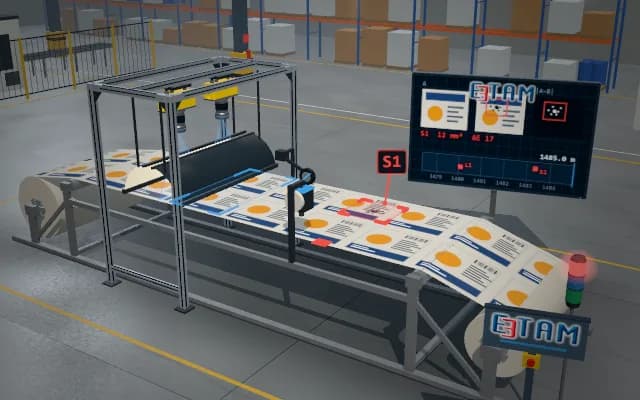
The printed web passes under a calibrated colour line-scan camera in a cabinet shielded from ambient light. The colour of defined print regions is compared with the reference at every repeat; the deviation map and trend chart are monitored, and a review alert for the press setting is raised when the trend crosses the limit.
The colour difference per region is written to the deviation map and trend chart on the control display; when the trend crosses the limit a review alert for the press setting is raised, and the values are added to the roll record.

- 01 Scan
- 02 Region measurement
- 03 Compare
- 04 Trend
The web passes the cabinet; the colour image is acquired line by line and corrected with the white reference.
- Colour difference
- —
- Trend
- —
- Region
- —
Scenes are illustrative simulations; they are not customer references or performance guarantees.
Need
Colour deviation develops slowly: ink density, viscosity and temperature drift over time. On a single print the difference cannot be seen, but the tone separates between the start and the end of the roll. Ambient light and camera warm-up can shift the measurement by the same amount.
Solution approach
Camera and symmetric bar lights work in a closed cabinet; a white reference tile at the web edge is in the image in every line, and drift of light and camera is corrected. The mean colour of the defined print regions is converted to a device-independent colour space, its difference to the reference is computed and followed as a trend over the repeats.
Process steps
- 01
Scan
The web passes the cabinet; the colour image is acquired line by line and corrected with the white reference.
- 02
Region measurement
The mean colour of the defined print regions is measured.
- 03
Compare
The colour difference of every region to the reference is computed and written to the map.
- 04
Trend
The colour difference is followed over the repeats; a review alert is raised if the limit is crossed.
Related applications





Let us assess your application together
We test your sample in our laboratory and report on resolution, optics and lighting selection.