
Foreign matter and quality inspection in film and foil production
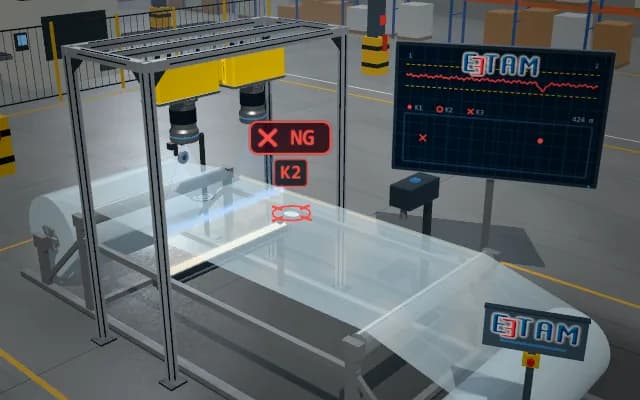
The film is lit from below by a bar light and scanned line by line across its full width by line-scan cameras triggered by the encoder pulse. Black specks, gels and holes are found where the line signal crosses its thresholds; they are logged on the roll map with class and position and the film edge is flagged.
Every defect is written to the roll map with class, cross-web position and roll metre; the edge labeller marks the film at that point. If defect density exceeds its limit an alarm goes to the line PLC and the roll slitting plan is updated.
- 01 Web run
- 02 Scan
- 03 Classify
- 04 Log
The film runs through the inspection span at constant speed; the encoder emits a pulse for every line.
- Roll position
- —
- Signal deviation
- —
- Defect class
- —
Scenes are illustrative simulations; they are not customer references or performance guarantees.
Need
In clear film a gel or a pinhole gives very low contrast; the film runs fast, vibrates and flutters slightly. A defect can be anywhere across the width and smaller than a millimetre; missing a single line means missing the defect.
Solution approach
Transmitted light from below turns the film into a bright field: an opaque speck appears dark, a gel as a refraction trace, a hole as excess brightness. Two line-scan cameras share the width and take one line per encoder pulse, so lines stitch evenly regardless of speed. Each line profile is compared with an upper and a lower threshold; a region beyond them is classed by contrast sign and shape.
Process steps
- 01
Web run
The film runs through the inspection span at constant speed; the encoder emits a pulse for every line.
- 02
Scan
Bar light below, two line-scan cameras above: the full width is scanned without gaps.
- 03
Classify
The region that crosses the threshold is extracted and classified by contrast and shape.
- 04
Log
The defect is logged on the roll map and the film edge is flagged with a label at that point.
Related applications



Let us assess your application together
We test your sample in our laboratory and report on resolution, optics and lighting selection.