
Pattern, colour and edge inspection of parquet and laminate
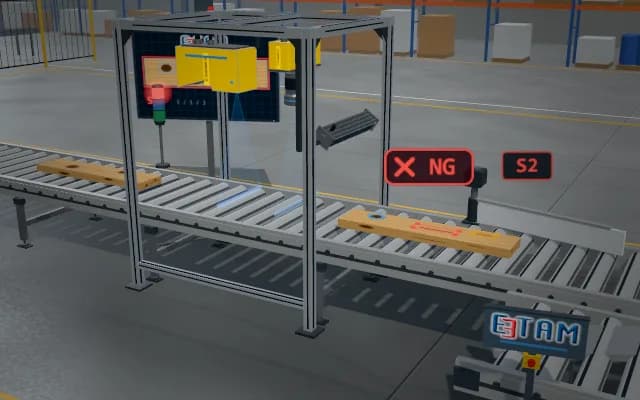
Boards leaving the profiling machine enter the cabinet in single file; a colour area camera under a dome light sees the surface pattern and tone, side cameras see the locking profile under low-angle light. The colour difference from the reference tone is computed and edge chips and lock damage are searched; the board is routed by tone class to one of two flaps and a defective board is rejected.
The tone class and defect result are sent to the line PLC; class A and B boards go to their own stacking lane through separate flaps and a board with a chipped edge goes to the reject bin. Class counters are shown on the operator display.

- 01 Infeed
- 02 Acquire
- 03 Colour
- 04 Edge
- 05 Route
Boards from the profiling machine enter the cabinet in single file.
- Colour difference
- —
- Edge chip
- —
- Tone class
- —
Scenes are illustrative simulations; they are not customer references or performance guarantees.
Need
Decor paper and lacquer are glossy; when the light angle changes the same board appears in a different tone. The shade difference is too small to notice by eye yet obvious once installed, and a chip in the locking profile is narrow and the same colour as the surface.
Solution approach
The dome light lights the surface evenly from all sides without shadows or glare; colour temperature is held constant and the camera is calibrated against a reference tile. The mean surface colour is compared with the reference to give the colour difference; the pattern is aligned with the template to measure shift. Side cameras see the lock profile under low-angle light and search for chips.
Process steps
- 01
Infeed
Boards from the profiling machine enter the cabinet in single file.
- 02
Acquire
A colour image is taken under the dome light and lock profile images from the side cameras.
- 03
Colour
The mean colour is compared with the reference, the pattern is aligned and the tone class is assigned.
- 04
Edge
The locking profile and edges are searched for chips and missing section.
- 05
Route
The board is diverted by flap according to tone class; a defective board goes to the reject bin.
Related applications


Let us assess your application together
We test your sample in our laboratory and report on resolution, optics and lighting selection.