
Line sorting of cut timber by end-face quality
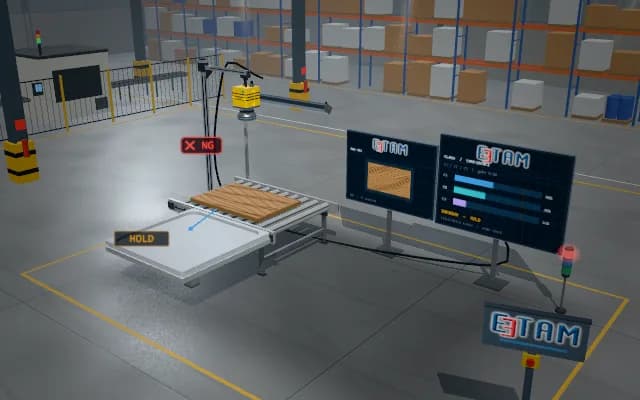
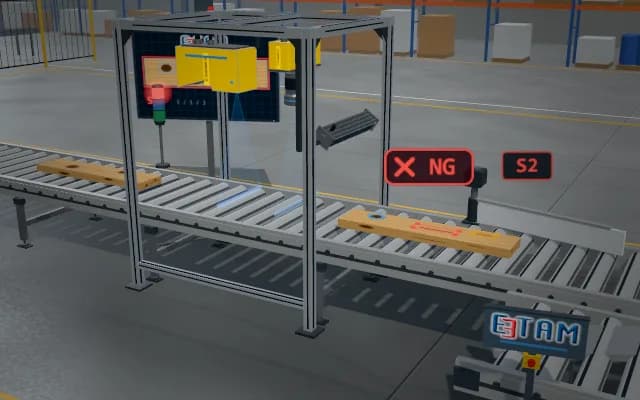
A side camera and oblique light inspect timber end faces. End cracks are distinguished from natural growth-ring texture; accepted grades continue straight while a rotary gate routes non-conforming pieces to a side line.
End-face grade, finding region and output decision are recorded. The PLC synchronizes the diverter with part position; timber with non-conforming end faces is separated onto the side line.

- 01 Infeed
- 02 Trigger and acquire
- 03 Analyse
- 04 Class and position
- 05 Controlled sorting
Rollers bring timber to end-face inspection.
- Accepted class
- —
- Decision score
- —
- Target output
- —
Scenes are illustrative simulations; they are not customer references or performance guarantees.
Need
Growth rings, coarse saw marks and resin tones can resemble cracks on an end face. The cut face itself and post-cut handling must be evaluated separately from general timber surface grading.
Solution approach
A roller line stops the part and presents its end face to a side camera. Oblique lighting emphasizes gaps and edge discontinuities; the image class is compared with natural ring texture. The PLC tracks position and opens a rotary diverter for the side output.
Process steps
- 01
Infeed
Rollers bring timber to end-face inspection.
- 02
Trigger and acquire
The side camera images the end face under oblique light.
- 03
Analyse
Ring texture and end cracks are evaluated together.
- 04
Class and position
The quality grade is linked to diverter position.
- 05
Controlled sorting
The gate rotates and diverts a non-conforming part to the side line.
Related applications


Let us assess your application together
We test your sample in our laboratory and report on resolution, optics and lighting selection.