
Knot, crack and resin-pocket grading of sawn timber
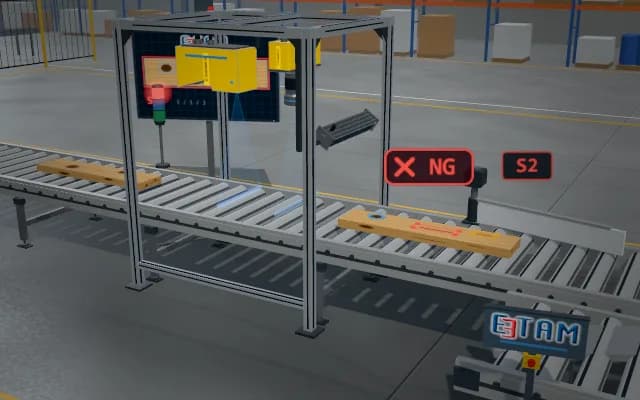
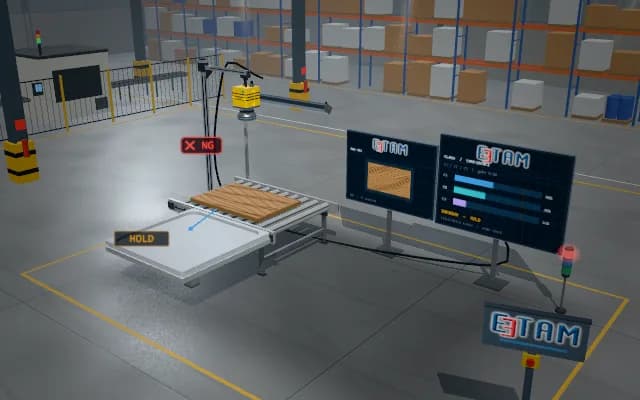
As the board travels on the roller conveyor, a laser profile sensor above it scans the surface across the width while an intensity image is captured at the same time. Grooves in the height map are separated as cracks and splits; dark and amber regions in the texture are classified as knots and resin pockets. The result goes to the cutting plan and the sorting flap.
The defect map and grade code are sent to the cut optimiser; an off-grade board is diverted to the second lane by the sorting flap and the defect positions are written to the board record.
- 01 Infeed
- 02 Scan
- 03 Map
- 04 Classify
- 05 Decide
Boards advance on the roller conveyor in sync with the encoder.
- Knots
- —
- Crack length
- —
- Grade
- —
Scenes are illustrative simulations; they are not customer references or performance guarantees.
Need
Grain, knots and drying cracks appear in the same dark tones; from the intensity image alone a crack cannot be reliably told from dark grain, nor a resin pocket from a wet stain. The bow of the board also changes the surface height.
Solution approach
The laser profile sensor gives the height profile across the board; successive profiles form the height map, and grooves are counted as cracks according to their depth and width. In the intensity image taken from the same scan line, knots and resin pockets are separated by a deep-learning classifier trained on natural grain samples. The combined map of both channels is applied to the grading rule.
Process steps
- 01
Infeed
Boards advance on the roller conveyor in sync with the encoder.
- 02
Scan
The laser line gives the height profile across the board; the camera takes the intensity image from the same line.
- 03
Map
Profiles are merged into a height map; grooves and dark regions are separated.
- 04
Classify
Each region is classified as knot, crack or resin pocket and the grading rule is applied.
- 05
Decide
The grade code goes to the cutting plan; an off-grade board is diverted by the flap.
Related applications


Let us assess your application together
We test your sample in our laboratory and report on resolution, optics and lighting selection.