
Model recognition and weld defect detection on seat frames
A seat frame arriving on an overhead conveyor passes a multi-camera station. A deep-learning model classifies which vehicle model the frame belongs to and looks for anomalies in the weld seams and the coating. A frame that does not match the order sequence, or a defective one, is diverted to a side line.
The class and defect result go to the line PLC with the carrier number; a frame that does not match the order sequence or is defective is switched to the repair line, and the images are added to the traceability record.
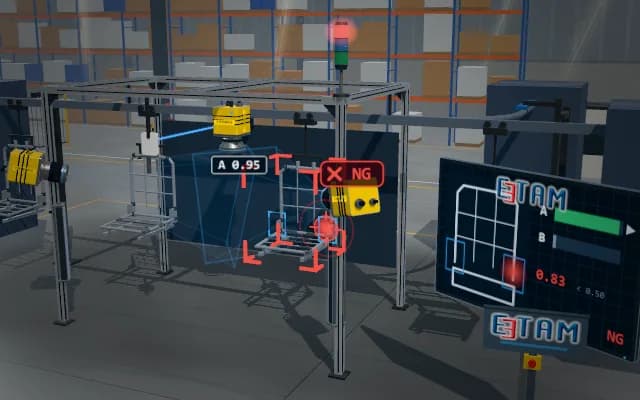
- 01 Infeed
- 02 Acquire
- 03 Classify
- 04 Defect analysis
- 05 Decide
The frame approaches the station on its carrier.
- Model
- —
- Class confidence
- —
- Anomaly score
- —
Scenes are illustrative simulations; they are not customer references or performance guarantees.
Need
The frame is an open cage of tube and sheet metal; the background shows through it and the seams face different directions. The appearance of a weld seam varies from part to part, while model variants differ only by a few brackets.
Solution approach
Three cameras image the frame from different angles at the same moment; bar lights illuminate the seams from the side. A classification network returns the model variant; in the seam regions an anomaly model trained on good samples marks porosity, missing seams and coating defects as a heat map.
Process steps
- 01
Infeed
The frame approaches the station on its carrier.
- 02
Acquire
Three cameras capture at the same moment.
- 03
Classify
The deep-learning model returns the frame variant.
- 04
Defect analysis
An anomaly heat map is computed in the seam regions.
- 05
Decide
The class is checked against the order sequence and the score against the threshold.
Related applications




Let us assess your application together
We test your sample in our laboratory and report on resolution, optics and lighting selection.