
Waste sorting and classification (textile, glass, plastic, paper)
Mixed waste on the belt is imaged from above; material class, position and orientation are derived from shape, texture and colour features. Tracking the belt, the robot places objects of the target classes in their bins; non-target material leaves at the belt end.
Class, pick point and orientation are sent with the belt position to the robot controller, which drops the object into the bin of its class. Objects that are not picked fall into the residue bin at the belt end; class counters are shown on the operator display.

- 01 Infeed
- 02 Acquire
- 03 Classify
- 04 Robot pick
- 05 Place
Mixed waste arrives under the camera spaced out on the belt; the photo-sensor sees the object.
- Material class
- —
- Cross-belt pos.
- —
- Orientation
- —
Scenes are illustrative simulations; they are not customer references or performance guarantees.
Need
Waste is crushed, dirty, wet and partly overlapping; two objects of the same class rarely look alike. The object never stops on the belt, so class, pick point and orientation must come from a single frame and be carried forward with the belt speed.
Solution approach
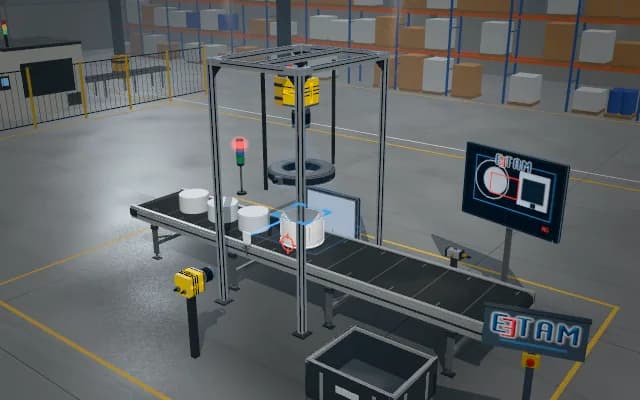
The gantry camera looks straight down at the belt; the ring light strobes on the photo-sensor trigger for a shadow-free, blur-free frame. The object is separated from the background and classified from contour and texture statistics; the widest flat region becomes the pick point, the main axis sets the gripper angle. The encoder ties position to belt speed, so the robot picks the object in motion.
Process steps
- 01
Infeed
Mixed waste arrives under the camera spaced out on the belt; the photo-sensor sees the object.
- 02
Acquire
The ring light strobes and the top-view camera captures the object.
- 03
Classify
Image processing determines the material class, pick point and orientation of the object.
- 04
Robot pick
The robot tracks the belt speed and picks the object with a vacuum gripper.
- 05
Place
The object is released into the bin of its class.
Related applications



Let us assess your application together
We test your sample in our laboratory and report on resolution, optics and lighting selection.