
Robotic sorting of electronic-waste boards by visual grade
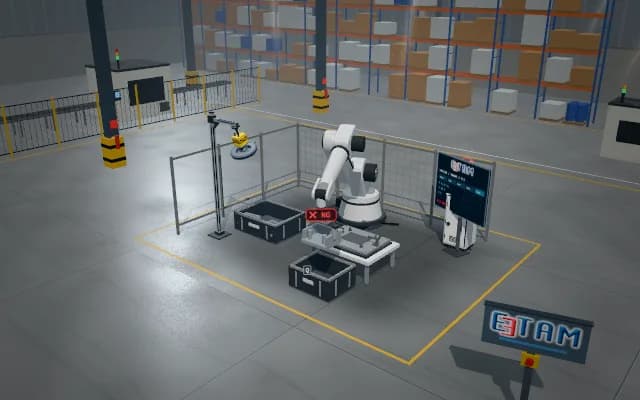
Electronic-waste boards are imaged under controlled lighting. Visible component density and board morphology become a grade; the robot transfers accepted boards to a recovery bin and uncertain examples to a review bin.
Visual grade, decision score, grip pose and target bin are sent to the PLC and robot. An uncertain board is routed to review; this concept does not estimate economic value or metal content.

- 01 Infeed
- 02 Trigger and acquire
- 03 Analyse
- 04 Class and position
- 05 Controlled sorting
The board advances to the imaging position.
- Accepted class
- —
- Decision score
- —
- Target output
- —
Scenes are illustrative simulations; they are not customer references or performance guarantees.
Need
Board component layouts, broken edges and arrival angles vary. A visual grade cannot substitute for direct chemical measurement of material composition or economic value.
Solution approach
An overhead camera, ring light and trigger sensor acquire a stable board image. The outer contour and visible component distribution are classified together. Pose is transformed to robot coordinates; an example with insufficient decision score is assigned to review.
Process steps
- 01
Infeed
The board advances to the imaging position.
- 02
Trigger and acquire
The photo-sensor triggers an overhead board-face image.
- 03
Analyse
Contour and component appearance contribute to a grade score.
- 04
Class and position
Grip point and target bin are assigned to the controller.
- 05
Controlled sorting
The robot lifts the board and lowers it into the selected bin.
Related applications



Let us assess your application together
We test your sample in our laboratory and report on resolution, optics and lighting selection.