
Porosity detection on machined cast surfaces
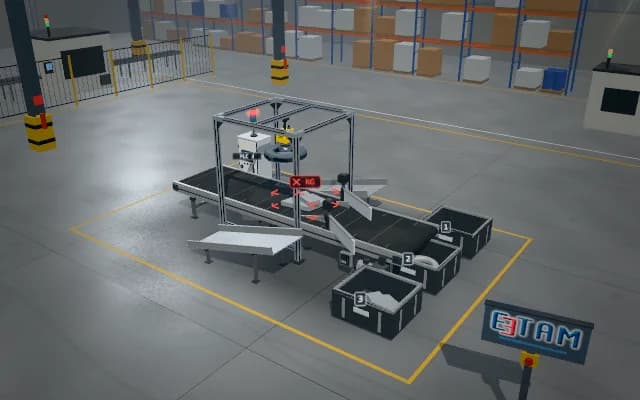
The machined gasket face of a palletised casting is imaged under a dome light. Deep learning marks pores distinguished from tool marks by size and location; the NG pallet is diverted to a side lane.
Pore count, illustrative area and region result are displayed. The NG pallet is transferred to a side lane by the pusher; the stack light repeats the routing decision.

- 01 Pallet
- 02 Acquire
- 03 Segment
- 04 Route
The casting arrives at the imaging position.
- Pore count
- —
- Pore area
- —
Scenes are illustrative simulations; they are not customer references or performance guarantees.
Need
Tool marks, oil stains and chips on a reflective machined face can resemble dark pores. A void on the gasket face is evaluated differently from one of the same size outside it.
Solution approach
Dome lighting reduces directional reflections while an overhead camera captures the gasket perimeter in one image. Deep-learning segmentation separates pores and evaluates them against the critical-face mask; single-pore and cluster examples are compared.
Process steps
- 01
Pallet
The casting arrives at the imaging position.
- 02
Acquire
After the photo-sensor trigger, the dome strobes and the gasket face is imaged.
- 03
Segment
Pore regions are separated from tool marks and compared with the gasket mask.
- 04
Route
The nonconforming pallet is transferred to the side lane.
Related applications



Let us assess your application together
We test your sample in our laboratory and report on resolution, optics and lighting selection.